Translate

Tuesday, June 30, 2009

DIY Solar Hot Water

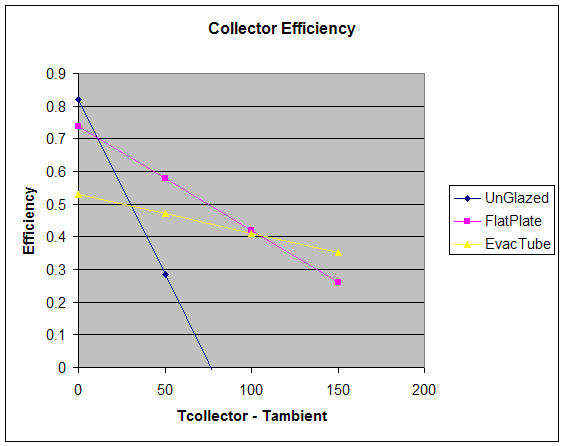
Some things have been nagging me lately about solar hot water collectors. Take a look at this chart.


You can find this graph here and they also say the following about the evacuated tube:

(Note -- it appears that the low efficiency of evacuated tubes at low delta temperatures is due to the fact that the SRCC uses the full area of the collector array when calculating performance, and the evacuated tube arrays have lots of open space that do not collect. This brings down their efficiency. If you calculate efficiency based on absorber area, the evacuated tubes are near 80% at the intercept. But, it seems to me that the SRCC is correct in basing the efficiency on the actual size of the array -- that's how much roof space it takes up).

So it appears that the evacuated tubes are only efficient when you look at the absorber area (the black inner tube area). But since there is space taken up by the outer glass shell and there is space between each tube in the array, then the effective efficiency goes down. If you are trying to boil water, then sure, these are great. But in my opinion, way too expensive for what you get in a normal water heating situation.

If you look at the unglazed part of the graph, this is like the pool heaters. They are just flat black plastic that the water flows through. They are really efficient when the outside air temp is close to the water temp.

What I propose is to use an inefficient design that doesn't raise the water temp very much. But the good part is the massive surface area that it utilizes. Most solar water collectors are between 10 and 30 square feet. I propose something like 800 square feet. Like the roof of your house.

Imagine using a homemade plywood water tank like here


http://www.builditsolar.com/Experimental/PEXColDHW/TankConstruction.htm . It is 160 gallon, but you could make it up to 300 gallons. It would store the water that is circulated to the roof. Inside the tank would be some PEX hose that goes to the pool pump and another length of hose that goes to the water heater in the house and a small circ pump for that. The pool has its own pump. You could also have a loop for a hot tub as well. The water that goes to the roof never comes in contact with the water that goes to the pool or hot water tank. It just transfers heat to it inside the plywood tank. In other words, the PEX tubing acts as a heat exchanger because it sits inside 160 gallons of hot water that is circulated to the hot roof and back again.

With the hot water tank, you might need to purchase an anti-scald valve because the water temp could get above 150F or so. On average you will probably see about 50 degrees F above ambient air temp on sunny days. But that is great for adding heat to the pool in the spring and fall. And good hot water for the house in the summer.

You could build a tank and get a pump for pushing water to the roof and a small circ pump for the house hot water and various piping for about $500. But a typical solar hot water device could be $2,000 up to $8,000. You could use a soaker hose at the roof peak or you could use a sprinkler head pointed at the right spot or however you would like to do it. But let's say you have a 20 foot by 40 foot area of the roof that gives you 800 square feet of heating area. This also helps cool your house in the summer.

At 70F sunny day and water temp at 100F, therefore 30F delta temp:
20 sq. ft flat plate - 65% eff. ==> 1209 watts of power
20 sq. ft evac. tube - 50% eff. ==> 930 watts
800 sq. ft roof area - 50% eff. ==> 37,000 watts

At 90F sunny day and water temp at 130F, therefore 40F delta temp:
20 sq. ft flat plate - 60% eff. ==> 1116 watts of power
20 sq. ft evac. tube - 48% eff. ==> 893 watts
800 sq. ft roof area - 38% eff. ==> 28,272 watts

At 70F sunny day and water temp at 130F, therefore 60F delta temp:
20 sq. ft flat plate - 55% eff. ==> 1023 watts of power
20 sq. ft evac. tube - 45% eff. ==> 837 watts
800 sq. ft roof area - 15% eff. ==> 11,160 watts

Of course you could get those flat black plastic pool heaters but it would take 8 of the big ones and about $2500 or more for 8 of those.

One problem with the rooftop waterfall heater is evaporation on the roof. I'm sure that even with that, just the sheer surface area will ensure massive amounts of heat being added. I'll have to test a small version and see how much evaporation affects it and how much make up water would be needed. But like they say, "Surface area is king". Another thing to consider is the color of your roof. A black roof will be much more efficient than a grey roof or a red roof, etc. Also, remember that the water is actually touching the hot surface. Unlike normal, where the heat has to transfer through a metal pipe or plastic just to get to the water.

Richard

Monday, June 29, 2009

Pizza Box Solar Oven

I first noticed the pizza box solar oven about 2 weeks ago. But everyone that tried it could not get it to work right. I figured that the problem was that the inside had aluminum foil on it that was not painted black. And a slight thermal mass was needed inside. So, I started to search to see if someone had painted the inside black and got one to work. I found these videos on youtube in 4 parts.


Richard

Friday, June 26, 2009

Cheap source of bearings

One of the toughest things to find over the last few years has been bearings. Especially when I was looking for free or nearly free. I have a friend that would give me a couple every now and then but that was few and far between. Usually, when I was testing a windmill blade design or vertical axis wind turbine design, I would have to order some bearings. After getting a shaft and two bearings plus shipping, the cost was about $70 or so. That was just too expensive and just too limiting. For the kind of testing I do, I needed more than a couple of bearings. I need several sets. They need to be cheap and readily available without ordering through the mail or driving 30 minutes to go to a specialty store.

Well, a couple of months ago, I found just the place. A thrift store. Yep, a thrift store. I found a skateboard for $2 one day and thought I would try it. I found out that the skateboards and the roller blades use the "608" bearing. After some research I found that each bearing can support up to about 900 lbs radially and up to about 400 lbs axially. Each skateboard or rollerblade wheel has 2 bearings inside. The weight pushing down on the wheels would be radial load. In theory each wheel could handle 1800 lbs of downward thrust, except for the fact that the rubber in the wheels would squish around the edge of the bearing and stop it from turning due to friction. Not sure what "real world" weight limit would be with the rubber wheels, but it is significant for brief periods. When you slide sideways, while skating, that is the axial thrust. But don't be tricked here. The axial load limit isn't doubled due to two bearings in this case. Only one bearing at a time takes that load depending on which way the slide is. That is why they have two bearings.
The inside diameter of a 608 is 8 mm, but I found that I can use a 5/16 bolt to hold it. It is slightly smaller and that is what the skateboard chuck uses anyway. And you can find a skateboard every so often in a thrift store. But what you always find is roller blades. I saw 6 sets of rollerblades just 2 days ago in a thrift store for $5 a pair. That is 96 bearings for $30. You really can't beat that. I would recommend getting the adult sizes of roller blades because the smaller sizes may use cheaper bearings.

You can also find many videos on http://youtube.com about taking the bearings out and cleaning and relubing. A lot of people use a good bearing oil but they don't seem to understand that with oil you have to relube once a week or more often. Oil is light and does make the wheel spin faster with your hands, but real world testing with oil and grease show that grease is just as fast under load after the first 20 to 30 seconds of warmup. And a greased bearing can go for months or even years without having to be cleaned and relubed. So, if you are doing windmill applications, please grease the bearings. It waterproofs the bearings, it pulls dirt away from the roller surfaces, and requires much less maintenance.

Here is the bottom bearing for a 65 lb vertical windmill I was testing.


But remember, in this case the bottom bearing is supporting all the weight and that is axial load. So, 400 lbs would be the limit. Although, I would say 200 lbs would be the limit just to be safe. Especially since these bearings are meant to have radial thrust most of the time. The radial thrust in this case would be from the wind and up to 3600 lbs of that would cause the wood to snap very easily and the wind would be hurricane forces.

By the way, this test didn't work that great. Adding more blades helps, but a regular savonious works better.

Richard

Thursday, June 25, 2009

Nature Mill indoor composter


This composter looks nice and very fast. It does consume 10 watts of power but it looks really convenient. I suppose it could be run off of solar power though. In the video they talk about lowering greenhouse gas emissions. This wouldn't do that. When plant matter breaks down in compost or in the woods, doesn't matter, it releases the same amount of water vapor and carbon dioxide ultimately. Just the speed in which it happens changes.

But, it is convenient and it saves loads of garbage going to the dump therefore saves in fuel costs for the garbage trucks and prevents greenhouse gases from that aspect.

It also replenishes the soil. Think of it this way. We humans are like machines. We grow enough food to "almost" feed all 6.5 billion of us. In doing so, we suck out all the nutrients from the soil as it is stored in the food. We eat the food and then it ends up in the sewer and then to a processing plant. So, most of it never gets back to the soil where it belongs. We are effectively pumping billions of pounds a day of nutrients from the soil and putting it elsewhere. That is really bad. We are methodically stripping just the nutrients from the soil and it is slowly rendering our food void of any value except to make us feel full. In other words, we as a species are slowly killing ourselves because we find composting toilets distasteful. Hmmmm, maybe we should rethink our positions.

Richard

Wednesday, June 24, 2009

Making some extra money for the summer

Well, the summer is always slow for my book sales. So, I've decided to make some extra cash by making arbors. I've made a couple before in the past just for me and my girlfriend. But this one is a step up and I'm selling it locally for $195 Canadian dollars. This is my first test, so we'll see how this one sells. Selling one a week would be nice, at least for the summer.

Since this is painted white it doesn't have to be cedar. In this case I used spruce and fir, much cheaper. It is always cool to design something on the computer or paper and then have it turn into reality. It always amazes me.

Richard