Translate

Showing posts with label DIY. Show all posts

Saturday, November 7, 2009

Colloidal / Ionic Silver constant current - Part 2

Part 2

This is the AC version parts:


AC version soldered.

AC version put in a cottage cheese container. Notice that it puts out a max of about 39 volts with no load.

Here I started with a very clean jar and some 99.99% pure silver Canadian maple leaf coins.
Well, I did some experiments with just the AC constant current and decided I didn't like it. It didn't seem very efficient even after running all night. I decided to add a full wave bridge to the circuit to make it a DC output. At that point it was running at 0.5 mA.
This worked much better. It starts with a higher voltage and maintains a constant current. As the silver ions go into the distilled water, the resistance drops. This means the voltage has to drop just to maintain constant current. On one batch it started at about 9 volts and on a different brand of distilled water it started at 28 volts. That means the second batch's water was way more pure, even though they are both distilled.

Here is a pic showing the new DC version running for a bit.

This shows the oxide layer forming on the negative coin.

I had to take it out and wipe it off about once every hour or two. It seemed to take a little less than 1 hour for every ounce of distilled water. About 45 minutes per ounce. A small 4 ounce glass would take about 3 hours and a big 16 ounce mason jar takes about 12 hours. But, you will want to stir it every so often. I just stirred it when I cleaned the oxide off the coin.

I would "cook" it until the voltage output dropped to about 3 to 4 volts. The water would still be perfectly clear. But after a few days it would turn a amber color. I also would filter mine through a non-bleached coffee filter.

Here is a batch after sitting a few days. The jar was wrapped in aluminum foil to keep the light out. (Since this batch and switching to 45 minutes per ounce at 0.5mA, the water stays clear indefinitely. ) This picture shows what happens when cooking for 7 hours when it should have been about 3 or 4 hours. Although it did take a few days to turn amber.

That is a laser being shown though the liquid. This effect is the tyndall effect and it works even when the water is still clear. If you try it with just distilled water you will not see the laser path at all. So this is a good way to test as you are getting close to being done. And you can see something is happening because the voltage is steadily moving down.

Remember that the higher the voltage starts at, then the more pure the water. But if you take the same water and use different sized pieces of silver like silver wire instead of coins, then the voltage will change as well. So, if you are consistent, you can compare different water qualities.

I found that drinking it doesn't seem to help as much as gargling it and swishing it around in your mouth. Once it gets in your stomach, the ions interact with the stomach acid and form silver chlorides. The suspended colloids (about 15% of the solution) will go into your bloodstream. But gargling it gives you a much better absorption. You will need to gargle for 2 to 3 minutes and 3 times a day if you are sick.

Another great way is nasal spray. You can get a dark glass bottle and nasal spray top at most health food stores.

The other way, probably the best, is to use a nebulizer (ultrasonic). I haven't tried this though.
Let me know if you try this and what your experiences are.

thanks,
Richard


<------------ Back to Part 1
.
.
.
.
.
.
.

Friday, October 23, 2009

Colloidal / Ionic Silver constant current - Part 1

I've had some requests recently asking for a simple "poor man's" colloidal silver generator. I have seen a bunch of companies selling them online and they are all pretty expensive. I have seen a few hundred dollars or more. There are some cheap ones and plans for just using three 9 volt batteries, but those are dangerous. They don't make safe colloidal silver because they aren't constant current.

What happens is that you start with 27 volts and silver electrodes in the distilled water. As the ionic silver is formed in the water it causes the resistance of the water to drop. This makes the current increase and this causes larger particles of silver to form. As the resistance continues to drop, the current goes up and up. The body can't get rid of larger particles of silver. Small colloids and ionic silver atoms are easy to flush out though. The trick is to limit the current to less than a milliamp or so. I've developed two very simple circuits that limit the output to 40 volts and less than 1 mA (miliamp).


The above picture is the AC version that runs off of normal house voltage of 120 volts. The idea is really simple. You just need 3 identical resistors (all 47k or all 56k) and one small AC capacitor rated at 39nF (nanoFarads). The circuit is just a voltage divider and we are tapping into a 40 volt section. Just use two resistors in series in the R1 position and the third resistor in the R2 slot. You are supposed to use two resistors, but it is easier to get three 47k resistors than it is to find one 94k and a 47k for example. You could use the following web page to calculate different voltages if you need to:

http://www.raltron.com/cust/tools/voltage_divider.asp

If you have 240 volts for example, you could use a 270k for R1 and a 47k for R2. This gives a 35 volt output at no more than 0.7 mA before the capacitor. Try to use a total of 150k or a little more for 120 volts and use about 300k or a little more for 240 volts. This means about 0.2 watts and most of the small resistors are 1/4 watt.

The capacitor is calculated by using the following equation:


the AC capacitor equation.
A=amps
f=frequency in hz
c=capacitance..24 MFD is 0.000024 (you can use capacitance in MFD and divide by 1,000,000)
v=volts

A=2*PI*f*c*v

OR

c = A/(2*PI*f*v)


example with 220 nF (nanoFarad) at 120 volts 60hz
A = 2 * 3.1416 * 60 * 0.00000022 * 120
A = 1 mA

example with 39 nF at 40 volts 60hz
A = 2 * 3.1416 * 60 * 0.000000039 * 40
A = .59mA


The DC version is simple. You need three 9 volt batteries and a special type of diode called a current regulating or current limiting diode. HERE is a 0.75 mA version that only costs $1.94. And HERE is data sheet for a few others.

A typical 9 volt battery has about 350 - 500 mAH of capacity. At 1mA or less, the rating would go up quite a bit. But at 5 hours to make a batch of colloidal silver at 5mAH total each time, the batteries would die of old age before they actually run down.

But, in either case, AC or DC, you will need the following:
  • a very clean glass, final rinse with distilled water
  • two 99.9% or better silver wires or coins
  • alligator clip wires
  • distilled water
  • glass for storage that keeps the light out (or put in a dark place)
  • a AC appliance timer or some other reminder to stop the "cooking" process
When you do the first batch, have a multimeter hooked up to the silver probes as well. This way you can measure the initial resistance between the silver probes. It should be fairly high. Then set meter to voltage and turn generator on. You should see the correct voltage. After a few hours check back to see if the water is starting to turn slightly yellow. You can set the glass on a white sheet of paper to help see it better.

Your goal should be to have it mostly clear but with a slight yellow tint to it. Then turn of the generator and check resistance again. It should be much less than when you started. This way you know it was working. If that process takes 5 hours for a given volume, for instance, then next time you can just set the timer for about 4 hours.

The colloidal / ionic silver should be good for a couple of months if you keep it in a very dark place. Some uses are:

  1. spray for disinfecting surfaces
  2. mouthwash
  3. cleaning wounds
  4. use with a nebulizer to inhale
  5. body spray and sponge bath in a emergency situation
  6. eye drops
  7. ear drops
  8. hand sanatizing
  9. killing mold
  10. soaking toothbrush and brushing teeth
  11. good article and many more here
There is a lot more I could talk about, like testing with a laser light for colloids. Using a set distance and size of probe to come up with resistivity and equating that to conductance and then to a rough ppm number. But that is another day. It is late and I'm off to bed. This weekend I'll take some pics of my AC ionic / colloidal silver generator. I just had the parts lying around.

Richard

On to Part 2 -------->


Tuesday, June 30, 2009

DIY Solar Hot Water

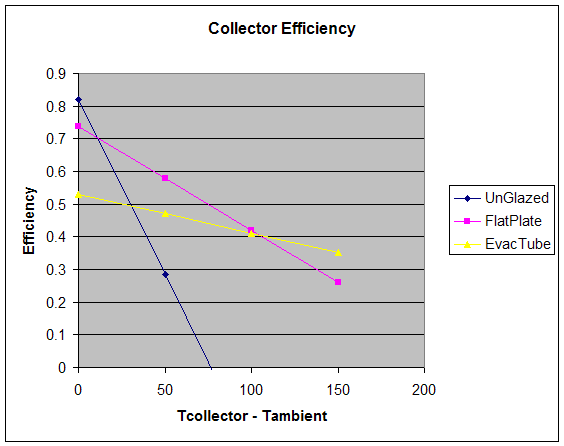
Some things have been nagging me lately about solar hot water collectors. Take a look at this chart.


You can find this graph here and they also say the following about the evacuated tube:

(Note -- it appears that the low efficiency of evacuated tubes at low delta temperatures is due to the fact that the SRCC uses the full area of the collector array when calculating performance, and the evacuated tube arrays have lots of open space that do not collect. This brings down their efficiency. If you calculate efficiency based on absorber area, the evacuated tubes are near 80% at the intercept. But, it seems to me that the SRCC is correct in basing the efficiency on the actual size of the array -- that's how much roof space it takes up).

So it appears that the evacuated tubes are only efficient when you look at the absorber area (the black inner tube area). But since there is space taken up by the outer glass shell and there is space between each tube in the array, then the effective efficiency goes down. If you are trying to boil water, then sure, these are great. But in my opinion, way too expensive for what you get in a normal water heating situation.

If you look at the unglazed part of the graph, this is like the pool heaters. They are just flat black plastic that the water flows through. They are really efficient when the outside air temp is close to the water temp.

What I propose is to use an inefficient design that doesn't raise the water temp very much. But the good part is the massive surface area that it utilizes. Most solar water collectors are between 10 and 30 square feet. I propose something like 800 square feet. Like the roof of your house.

Imagine using a homemade plywood water tank like here


http://www.builditsolar.com/Experimental/PEXColDHW/TankConstruction.htm . It is 160 gallon, but you could make it up to 300 gallons. It would store the water that is circulated to the roof. Inside the tank would be some PEX hose that goes to the pool pump and another length of hose that goes to the water heater in the house and a small circ pump for that. The pool has its own pump. You could also have a loop for a hot tub as well. The water that goes to the roof never comes in contact with the water that goes to the pool or hot water tank. It just transfers heat to it inside the plywood tank. In other words, the PEX tubing acts as a heat exchanger because it sits inside 160 gallons of hot water that is circulated to the hot roof and back again.

With the hot water tank, you might need to purchase an anti-scald valve because the water temp could get above 150F or so. On average you will probably see about 50 degrees F above ambient air temp on sunny days. But that is great for adding heat to the pool in the spring and fall. And good hot water for the house in the summer.

You could build a tank and get a pump for pushing water to the roof and a small circ pump for the house hot water and various piping for about $500. But a typical solar hot water device could be $2,000 up to $8,000. You could use a soaker hose at the roof peak or you could use a sprinkler head pointed at the right spot or however you would like to do it. But let's say you have a 20 foot by 40 foot area of the roof that gives you 800 square feet of heating area. This also helps cool your house in the summer.

At 70F sunny day and water temp at 100F, therefore 30F delta temp:
20 sq. ft flat plate - 65% eff. ==> 1209 watts of power
20 sq. ft evac. tube - 50% eff. ==> 930 watts
800 sq. ft roof area - 50% eff. ==> 37,000 watts

At 90F sunny day and water temp at 130F, therefore 40F delta temp:
20 sq. ft flat plate - 60% eff. ==> 1116 watts of power
20 sq. ft evac. tube - 48% eff. ==> 893 watts
800 sq. ft roof area - 38% eff. ==> 28,272 watts

At 70F sunny day and water temp at 130F, therefore 60F delta temp:
20 sq. ft flat plate - 55% eff. ==> 1023 watts of power
20 sq. ft evac. tube - 45% eff. ==> 837 watts
800 sq. ft roof area - 15% eff. ==> 11,160 watts

Of course you could get those flat black plastic pool heaters but it would take 8 of the big ones and about $2500 or more for 8 of those.

One problem with the rooftop waterfall heater is evaporation on the roof. I'm sure that even with that, just the sheer surface area will ensure massive amounts of heat being added. I'll have to test a small version and see how much evaporation affects it and how much make up water would be needed. But like they say, "Surface area is king". Another thing to consider is the color of your roof. A black roof will be much more efficient than a grey roof or a red roof, etc. Also, remember that the water is actually touching the hot surface. Unlike normal, where the heat has to transfer through a metal pipe or plastic just to get to the water.

Richard