Translate

Friday, June 10, 2016

VAWT (Savonious) Wind Turbine Calculator

I have done some work on my VAWT / Savonious Wind Turbine Calculator. It allows you to enter parameters and compute power output, amperage to batteries or the grid, cut in speed, etc. The program can be found here.

You start by selecting a battery voltage; 12, 24, or 48 volts. Alternatively, you may select 120 or 240 volts for grid tie. Weather conditions default to "moderate", but you may calculate for summer or winter as well. This is important because the temperature and density of the air can have a profound effect on the generator's cooling and therefore its maximum power output.

You can then enter the overall blade width. This is the width of the turbine as seen by its profile, not just one blade. Then enter the blade height.

The Gear Ratio field is used when your generator needs more speed to produce a usable voltage. Wind speed is entered in miles per hour. The calculations are based on this wind speed.

Tip Speed Ratio (TSR) is how fast the tips of the blades move in comparison to the wind speed. A typical horizontal axis wind turbine (HAWT) is usually between 3 and 10 TSR. A typical VAWT such as a Savonious is about 0.8.

The Blade Efficiency field also represents the Power Coefficient. A well-designed 2-blade Savonious has about a 24% Power Coefficient. A 3-blade has about 15%, although it does have more torque and works better at less than 23 mph or so.

The motor/generator's amp, volts, and RPM rating are usually given by the manufacturer. The generator's efficiency is a little different. Typically, a permanent magnet DC motor with brushes is about 50%. A three-phase permanent magnet alternator is about 75%, and an AC induction motor is about 90% (used for grid tie).




Monday, June 6, 2016

White roof to help keep cool

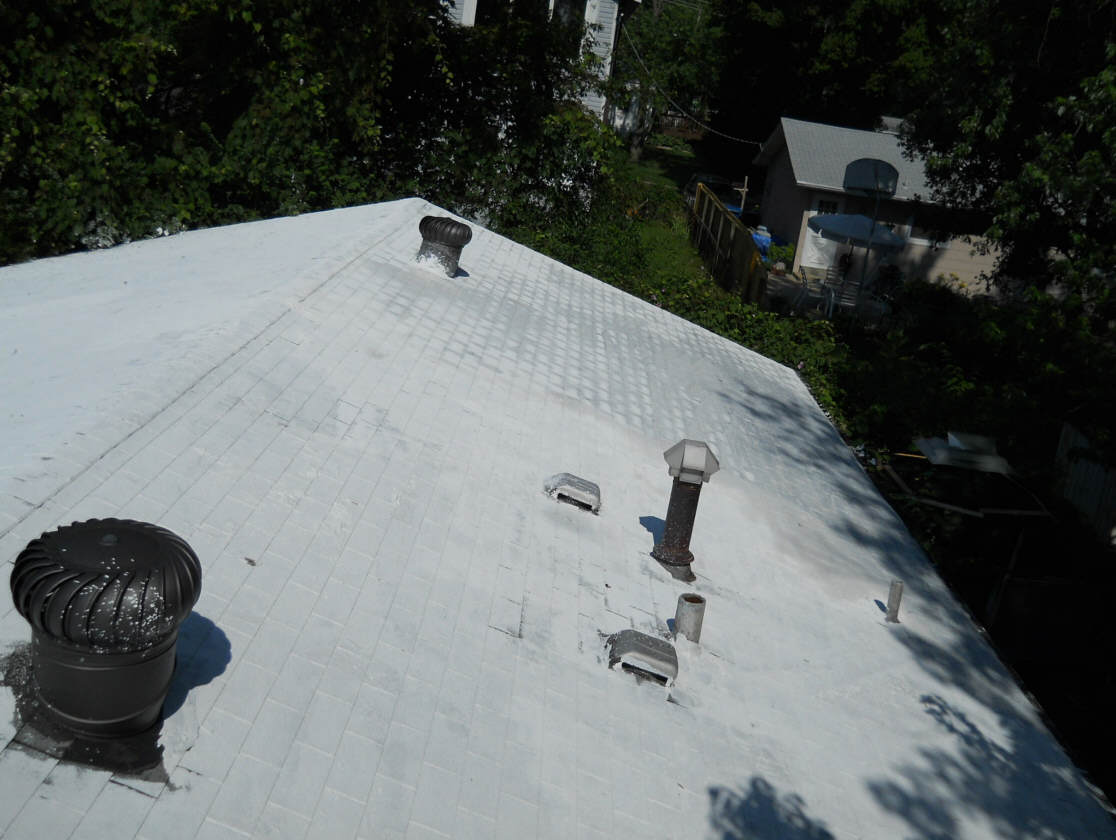
I've said for years that we should have white roofs. There is really no reason to have an attic get 120 to 150F. Everyone is just used to the dark shingled roof. Some do the metal roofs, but they are more expensive in the short run. But, this idea is really creative. This guy named David found he could coat his roof with lime and water (whitewash) and it lasted for a few years. Who knows how long it would last, but at $14 for materials, you could coat the roof every few years and still save a ton of money.

Note that in the picture below that the roof could use a couple more coats. But, this was just a test and it proved to work very well, even though the roof wasn't completely white.


His results were fantastic; 8F to 10F cooler in the house and 30 to 40 degrees cooler in the attic. Now, imagine mixing this idea with the cheap air conditioning idea I talked about back in 2010.


read more about the story here...

Richard

Sunday, June 5, 2016

So hot, time to revisit cheap air conditioning

Been so hot lately, I just wanted to point out the cheap air conditioning post from a few years ago. Check it out.


Survival Lilly comes to BC

I recently had the great pleasure of meeting Lilly, from the Survival Lilly channel on Youtube. I gave her and her adventure guide (Randall from SurviveBC) a lift from BC Ferries. We stopped off at a great little restaurant in downtown Victoria called Vista 18. Panoramic views, good food, and interesting conversation made for a pleasurable afternoon.

Lilly is a survivalist, if you haven't gathered already. And she has traveled all the way from Austria just so she can take a helicopter ride out into the "bush" at an undisclosed location, away from the things of man. There, she will rough it for 6 days, alone, with only her camera to keep her company. He is a great listener, but the conversations are a little one sided.

She is out there now in the dark. Hopefully, she managed to get a shelter setup and maybe catch something to eat for dinner. We just won't know how things went until someone hears from her in 6 days. Fingers crossed.

Richard

Saturday, April 30, 2016

Off-grid Electric Arc Furnace

I found this on the King of Random youtube channel. It is very interesting and has lots of uses. This particular version uses two microwave oven transformers on 240 VAC. This outputs about 20 to 40 volts at about 40 to 80 amps.

But, instead of using transformers and wall power, what if you used two reclaimed car batteries wired in series? And, what if you charged them with solar? This would make for a great off-the-grid metal furnace. And, with car batteries and bigger electrodes, you could have a much bigger furnace.