Translate

Thursday, September 17, 2009

Underground Cold Storage


If you don't have a underground cold storage and you have freshly picked fruits and vegetables to store, don't worry, you can make your own. I first heard of the idea using a metal garbage can. Just dig a hole, put the can in. Fill with things you want to store through the winter and then put the lid on and cover with hay.

In the above picture I thought a regular fridge would work. Just means digging a bigger hole. It does have a nice rubber and magnetic seal and the whole thing is insulated. I would still recommend putting hay over it. A small free standing cover would be nice so when it is icy and snowy outside, you can still open it and get things out.

One word of advice, don't put apples in with anything else. Keep them seperate. I remember reading that the apples off gas something and it will make potatoes turn green. Don't remember the details though.

Thursday, September 10, 2009

Wind Power when the Wind Stops

I know there is a big concern about wind and solar in which their intermittent nature may cause problems. The propaganda being pushed on the net is that they have to make back up coal burning power stations to go along with every wind farm to take up the slack when the wind isn't blowing. This sounds right at first glance but after careful consideration just doesn't hold up.

In reality, the wind farm is there to augment the existing electrical production so it offsets the use of fossil fuels. In other words, no backup coal power plant is needed. The wind farm means that whenever the wind is blowing then there is less coal or natural gas being burned. This is a good thing.

The only time it becomes a problem is when you get close to 20% of your power production coming from wind. Right now we are only at about 1.3%. But when that time comes, there are much better ways to deal with downtime than just making more coal power plants. One example is pumping air underground.
There are two ways to do it. The picture above shows the more inefficient way. But this is the only cheap way to retrofit an existing wind farm. It feeds the grid with electricity from the windmill and uses some of the power to pump air under ground into a empty natural gas well. When the wind isn't blowing, the compressed air will turn air motors or turbines that spin generators to make electricity.

The second way is to use wind turbines that have the air compressor built in instead of the generator. You can read more about it here.

Richard

Wednesday, September 9, 2009

Utility wants to deploy largest grid battery ever

This story is all about "green washing" and corporate criminals that want to take advantage of new public moneys.

http://www.reuters.com/article/GCA-GreenBusiness/idUSTRE57P4PJ20090826

Basically we are looking at a power company and a lithium ion battery manufacturer making huge sums of money through grants from the Dept of Energy. What they fail to mention is that lithium ion batteries are only good for about 2 to 3 years and then they have to be replaced. So, it isn't just a one time grant. It is an ongoing cell replacement scenario. Why put some awesome, lightweight, high density batteries in a warehouse that could just as easily house cheaper lead acid batteries? The most effective recycling program in the world has been the recycling of lead acid batteries. About 98% effective. And large cells like in forklifts can last 10 to 20 years. Lithium ion is great for laptops, drills, cars and scooters because they take up very little space and they are lightweight. In a huge factory size doesn't really matter and, of course, neither does the weight.

But, really, why use batteries at all for this scenario? Wind and hydro can take up slack in the grid system all the way up to about 20%. And only then do you need to look into some backup system. And when and if we get to that point we could use other methods such as compressed air storage underground in abandoned gas wells. Or we could pump water up to the top of a hill and use hydroelectric at the low wind times.

Richard

Monday, August 31, 2009

Homemade Deep Well Hand Pump

I found this site today and the "well" page is pretty interesting.
http://www.fdungan.com/well.htm

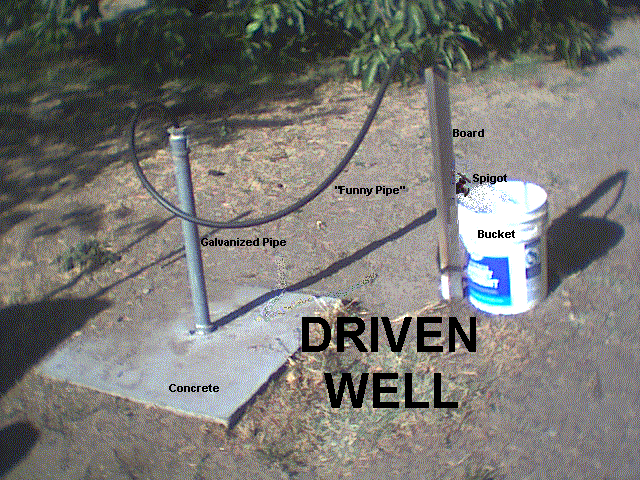
It talks about driving your own 80 foot well with a wooden hammer or a post pounder. And it explains the different type of wells and how to dig them. But I found this homemade hand pump the most interesting.

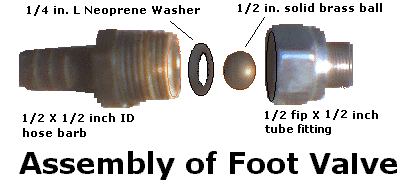
It is made of some hose adapters and a brass ball. It acts as a check valve. This goes down in the well and is attached to some stiff UV resistant irrigation hose. When you pull it up and down it starts pumping water. It may take a lot of effort the first time you set this up but after that it is much quicker because it doesn't lose its prime. I estimate about 50 strokes per gallon.
Also, even if you are going to use an electrical pump, this manual pump still comes in handy for when you first dig the well. It allows you to clear out the sand and silt very quickly.

This type of pump will work for years and doesn't require maintenance. Pretty impressive for just a few bucks at the hardware store. Looks like it would be great for emergencies or for off grid water pumping.

Richard

Wednesday, August 26, 2009

Liar Liar Pants on Fire

Today I was browsing ebay looking at wind turbine stuff. I came across this link here. Here is an excerpt:

Wind Turbine 1000 watt. Complete system minus inverter and battery

This is the Best of the Best. Made in Michigan. Made in the U.S.A.

This high out put 1000 watt Wind Turbine is the best out there to start with;

The frame is made of 6061 aluminum aprox 52 inches long strong yet light. bolted together with stainless steel washers nuts and bolts. This unique designed lets you install the wires down the center of the tube so the wires wont get tangled up.This is truly a work of art.

Dont buy a frame thats made out of cheap steel from china then welded by a amatuer and painted over, the frame will rust crack paint will chip off and will look terrible in weeks

This heavy duty motor/generator can produce a 1000 watts as a wind generator. The wind generator is rated for 130 volts dc 8 amps and reversible (creates electricity spinning in either directions they have thick magnets and brushes inside the housing. The outside housing is painted with white epoxy paint.The motor hits about 12 volts at 12 mph start up speed is about 3-4 mph. This is a awsome motor.

Dont waist your money with one of those 200 watt systems

These blades our the best out there. You get 3 turbo torque aircraft grade aluminum. The blades are about 5 inches wide at their widest and 24 inches in length (diameter of swept area is aprox 52 inches) with hub. These are cnc machined with a dimensional tolerance of .005 inches. They are perfectly balanced and spin very smooth.they are light strong and will not rust built to last , low wind start up about 3-4 mph. Our blades can with stand 70 mph.our blades our field tested and under go hundreds of hours of prototyping.

-------------

This upsets me. Some people read this and don't see the problems.

1) It says a 1,000 watts - and we know that 8 amps multiplied by 130 volts is 1,040 watts. But, in real life we are charging a battery. In this case a 12 volt battery. If the battery is maxed at 15 volts and you put out 8 amps then that is only 120 watts. But in cold strong wind you can get up to 3 times the current rating, making this a 360 watt wind turbine system at best.

2) It only produces 12 volts at about 12 mph wind. But a battery is usually 12.7 volts or more and the voltage drop across the diode is 0.7 volts. That means that you need 13.4 volts or more to start charging. So, with a 4.3 foot diameter blade (52 inches) that means on a breezy day when the average wind speed is about 17 mph, you would only average about 50 watts of power.

3)This is one of those cheap treadmill motor that has very poor bearings. It will break under high winds and prolonged use. These motors don't produce any usable power until you get to high rpms and that means it is a poor choice for wind turbine use.

4) If the blades are 30% efficient and the motor is 50% efficient, then overall the system is 15% efficient. When I put that in my motor analyzer, I get the following:

So, the part of the description that says don't waste your time with a 200 watt system is obviously misleading. This system is basically a 200 watt system in a "real world" situation.

5) Notice that I used a TSR of 5 and RPM of 4500. But, that is very generous of me since most treadmill motors have a 5,000 or more RPM rating. Also, TSR of 5 implies that the blades have lift. A curved surface alone will not make much lift. You need a curved leading edge and a sharp trailing edge. I'm guessing that this blade would have about a 3 to 5 TSR rating.

6) I like aluminum, but remember, even the best aluminum will get micro fractures at stress points and they build up over time. But the thick pvc pipe painted with titanium dioxide paint will last for years.

7) Just because the blades can handle 70 mph winds doesn't mean that the little bearings in that cheap motor can handle that for any length of time.

So, this is about a 200 to 300 watt wind turbine that needs a very breezy location to make any usable power. And the motor bearings will break in about 6 months to a year. There is a way to use these motors and make them last...but this aint it.

Richard